

.jpeg "Dr. P. K. Viswanathan - Faculty Director")


Download Brochure
Check out the program and fee details in our brochure

Thanks for your interest!
An advisor will be reaching out to you soon.
Not able to view the brochure?
View Brochure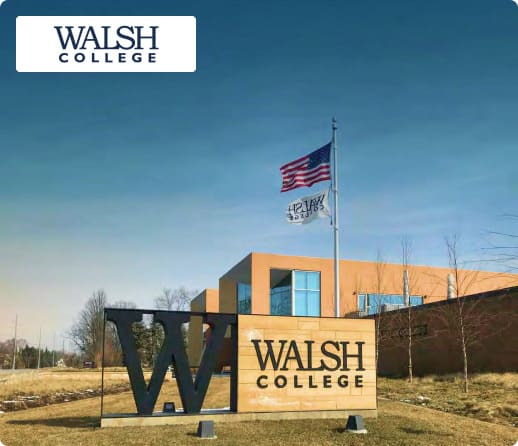
Get details on syllabus, projects, tools, and more

Industry relevant curriculum with modules on ChatGPT and GenAI
Application closes 28th Feb 2026

Designed for Working Professionals

Pursue MS in AIML for under USD 7500

12 Hands-on Projects and 30+ Case Studies

1 Capstone Project at the end of each Year

Get Alumni Status from Walsh College

No GRE/GMAT or TOEFL Requirement

Includes modules on ChatGPT and GenAI
Post Graduate Program in AI and ML
Foundations
PYTHON FOR AI AND MACHINE LEARNING
This course focuses on Python programming used for Artificial Intelligence and Machine Learning. Learners will work on a high-level idea of Object-Oriented Programming and later
learn the essential vocabulary (keywords), grammar (syntax) and sentence formation (usable code) of this language. This module will drive learners from introduction to AI and ML to the core concepts using one of the most popular and advanced programming languages - Python.
APPLIED STATISTICS
Learn the terms and concepts vital to Exploratory Data Analysis and Machine Learning in general. From the very basics of taking a simple average to the advanced process of finding statistical evidence to confirm or deny conjectures and speculations, learners will focus on a specific set of tools required to analyze and draw actionable insights from data.
INTRODUCTION TO DATA SCIENCE AND AI (SELF-PACED)
Gain an understanding of the evolution of AI and Data Science over time, their application in industries, the mathematics and statistics behind them, and an overview of the life cycle of building data driven solution:
The fascinating history of Data Science and AI
Transforming Industries through Data Science and AI
The Math and Stats underlying the technology
Navigating the Data Science and AI Lifecycle
Machine Learning
SUPERVISED LEARNING
Learn about Supervised ML algorithms, working of the algorithms and their scope of application - Regression and Classification.
UNSUPERVISED LEARNING
Learn about Unsupervised Learning algorithms, working of these algorithms and their scope of application - Clustering and Dimensionality Reduction.
ENSEMBLE TECHNIQUES
In this Machine Learning module, work on supervised standalone models’ shortcomings and learn a few techniques, such as Ensemble techniques to overcome these shortcomings.
FEATURIZATION, MODEL SELECTION AND TUNING
Learn various concepts that will be useful in creating functional machine learning models like model selection and tuning, model performance measures, ways of regularization, etc.
INTRODUCTION TO SQL
Know about SQL programming, such as DBMS, Normalization, Joins, etc.
Artificial Intelligence
INTRODUCTION TO GENERATIVE AI AND PROMPT ENGINEERING
This module offers a comprehensive exploration of two critical aspects of Artificial Intelligence. Through live sessions, learners will delve into the fundamental concepts and techniques of generative AI, a field known for its innovation and creativity. Learners will also master the practical applications of prompt engineering, including designing effective prompts, optimizing results, and exploring various prompt engineering techniques.
INTRODUCTION TO NEURAL NETWORKS AND DEEP LEARNING
In this Artificial Intelligence module, learners understand the motive behind using the terms Neural Network and look at the individual constituents of a Neural Network, installation of and building familiarity with TensorFlow library, appreciate the simplicity of Keras and build a deep neural network model for a classification problem using Keras. They also learn how to tune a Deep Neural Network.
COMPUTER VISION
In this Computer Vision module, learn how to process and work with images for image classification using Neural Networks. Going beyond plain Neural Networks, learners will also focus on a more advanced architecture - Convolutional Neural Networks.
NATURAL LANGUAGE PROCESSING
Learn how to work with Natural Language Processing with Python using traditional Machine Learning methods. Then, deep dive into the realm of Sequential Models and state of the art language models.
SELF-PACED MODULE: DEMYSTIFYING CHATGPT AND APPLICATIONS
Gain an understanding of what ChatGPT is and how it works, as well as delve into the implications of ChatGPT for work, business, and education. Additionally, learn about prompt engineering and how it can be used to fine-tune outputs for specific use cases.
SELF-PACED MODULE: CHATGPT - THE DEVELOPMENT STACK
Dive into the development stack of ChatGPT by learning the mathematical fundamentals that underlie generative AI. Further, learn about transformer models and how they are used in generative AI for natural language.
Capstone Project
Get your hands dirty with a real-time project under industry experts’ guidance. This covers everything from an introduction to Python and Artificial Intelligence to Machine Learning. Successful completion of the project will earn you a Post Graduate Certificate.
MS in AI and ML
Term 1
In this course, you will master CNNs, RNNs, LSTMs, autoencoders, and state-of the-art generative models like GPT, PaLM, CLIP, and DALL·E and gain the industry-critical skills of transfer learning, prompt engineering, and RAG & LoRA fine-tuning to create domain-specific AI systems ready for real-world impact.Database storage technologies have transformed into complex systems that support knowledge management and decision support systems. This course takes a look at the foundations of database storage technologies. Students will learn about database storage architecture, types of database storage systems (legacy, current and emerging), physical data storage, transaction management, database storage APIs, data warehousing, governance and big data systems. The student will tie this all together to see how database storage technologies apply to data analytics.
IT 547 : DATA STORAGE TECHNOLOGIES:
Database storage technologies have transformed into complex systems that support knowledge management and decision support systems. This course takes a look at the foundations of database storage technologies. Students will learn about database storage architecture, types of database storage systems (legacy, current and emerging), physical data storage, transaction management, database storage APIs, data warehousing, governance and big data systems. The student will tie this all together to see how database storage technologies apply to data analytics. Upon successful completion of this course, you will be able to:
Term 2
BTC 771 : AI STRATEGY FOR LEADERS:
The course integrates real-world case studies from industry leaders such as Tesla, Amazon,
JPMorgan Chase, and Microsoft, providing students with insights into AI successes and challenges. Through case study analyses, discussions, and practical assignments, students will develop leadership strategies for AI integration, ensuring responsible and effective AI adoption in their organizations.
QM 625 : Mathematics of Artificial Intelligence & Machine Learning
This course introduces and explains the fundamental mathematical concepts that form the backbone of artificial intelligence and deep learning. It emphasizes a strong understanding of linear algebra and analytic geometry, which are essential for building and optimizing AI models. Learners will explore how these mathematical principles directly apply to modern algorithms and neural networks. By the end of the course, participants will gain the analytical skills needed to interpret and implement AI techniques effectively.
Course Learning Outcomes:
Upon successful completion of this course, students will be able to:
Term 3
QM 625 : CAPSTONE PROJECT:
The Capstone Project provides the opportunity for integrating program learning within a project framework. Each student identifies or defines a professionally relevant need to be addressed that represents an opportunity to assimilate, integrate or extend learning derived through the program. The student will work with the Capstone Project Mentor to develop a proposal. After review and approval by the Capstone Project Mentor, the student will be authorized to complete the project.The student will present the completed project at the end of the semester.Upon successful completion of this course, you will be able to:
Learners will join the Post Graduate Program in AI and Machine Learning by The University of Texas at Austin and Great Lakes Executive Learning and receive PG certificates upon program completion.
Post completion of the PG Program in AI and Machine Learning, candidates will continue their learning journey with the MS in Artificial Intelligence and Machine Learning offered by Walsh College.
Successful learners will receive the MS in Artificial Intelligence and Machine Learning from Walsh College.
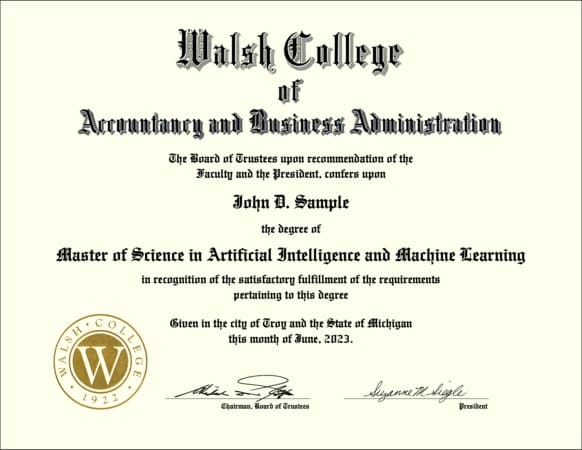
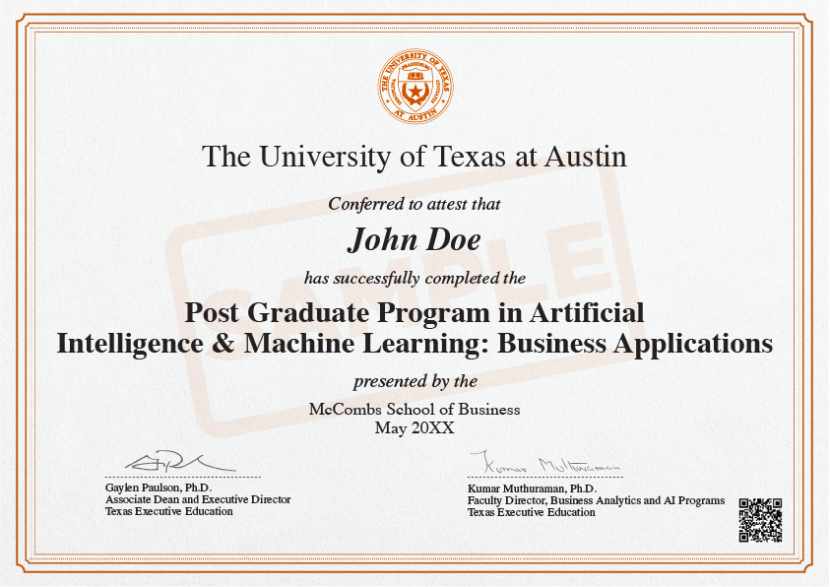
* Image for illustration only. Certificate subject to change.


Recognized by the U.S. Department of Education
Industry relevant syllabus

Python

Keras

Numpy

TensorFlow

Matplotlib

Scikit Learn

Seaborn

Statsmodels
Meet the experienced and world-class faculty who will teach you the core concepts of Artificial Intelligence and Machine learning

Chassis System Architect - General Motors

VP and Academic Dean

PhD, Adjunct Associate Professor

CIO/COO, Assistant Professor of IT
Note: The above faculty list is indicative

Join exclusive career fairs and hackathons with GL eXcelerate

Access our Job Boards where our team posts job opportunities from top organizations

Get 1 : 1 career mentoring with LIVE online sessions with industry professionals

Gain industry insights and set your career goals with mentorship
We provide students with sample SOP formats to guide them in crafting a compelling SOP.
Participate in mock interviews & get guidance from our alumni currently in roles you aspire for
Year 1 USD 4500
+Year 2*USD 3000
*The tuition fee is subject to change based on university's regulations.
Our admissions close once the requisite number of participants enroll for the upcoming batch. Apply early to secure your seats.

Fill out a fast and easy online application form. No additional tests or prerequisites are needed.

Our team will make contact with you by phone to confirm your eligibility for the program.

If selected, you will receive an offer for the upcoming cohort. Secure your seat by paying the fee.

If selected, you will receive an acceptance letter with instructions on how to pay and join the program.
Admissions Open
Program Details
The program offers the following key highlights:
The MS in Artificial Intelligence and Machine Learning is a two-year, fully online program offered by Walsh College.
The program is delivered entirely online, allowing learners to study from anywhere.
The MS in Artificial Intelligence and Machine Learning program is offered by Walsh College, a private, not-for-profit institution based in the United States.
On successfully completing this MS in AIML program, you will be able to:
The curriculum focuses on advanced applications of Artificial Intelligence and Machine Learning. It is designed to build both theoretical understanding and practical skills through hands-on projects, case studies, and real-world applications, preparing learners to apply AI and ML techniques in business and technology contexts. It includes modules on Generative AI, ChatGPT, Deep Learning, Computer Vision, Natural Language Processing, and Data Science.
Yes. The program includes 12 hands-on projects, over 30 case studies, and capstone projects at the end of Year 1 and Year 2.
Yes. Upon successful completion of the Year 1 requirements, you will earn a Post Graduate Certificate in AI and Machine Learning from The University of Texas at Austin and Great Lakes Executive Learning, in addition to the MS degree from Walsh College awarded after Year 2.
The program covers industry-relevant languages and tools, including Python, SQL, TensorFlow, Keras, and technologies used in Artificial Intelligence and Machine Learning applications.
Admissions and Eligibility
Note: Candidates should score a minimum of 2.75 CGPA in the 1st year to be eligible for the 2nd year of the program.
No. GRE, GMAT, TOEFL, or other English proficiency test scores are not required for admission.
Yes. Candidates must score a minimum CGPA of 2.75 in the first year to be eligible to continue into the second year of the program.
Great Learning provides end-to-end support for the Walsh College application process.
Step 1: APPLY ONLINE
Step 2: PRE-SCREENING
Step 3: APPLICATION ASSESSMENT
Step 4: JOIN THE PROGRAM
Note: Candidates should score a minimum of 2.75 CGPA in the 1st year to be eligible for the 2nd year of the program.
*Admission to the program is subject to Walsh College acceptance.
Yes. Great Learning provides end-to-end support throughout the Walsh College application process.
Fee and Payment
The total program fee is INR 5,50,000 + GST.
No. Admission to the program is subject to acceptance by Walsh College.
General Queries
Yes. Walsh College is accredited by The Higher Learning Commission (HLC), a regional accreditation agency recognized by the U.S. Department of Education.
Walsh College is recognized by World Education Services (WES), which helps learners validate their academic credentials for use in the U.S. and Canada.
Yes. Graduates receive alumni status from Walsh College upon successful completion of the program.
Yes. Learners receive career support through resume building, interview preparation, career guidance, and an e-portfolio to showcase projects and skills.
Yes. The curriculum is indicative and may be updated to reflect academic or industry requirements.


2025-05-15 08:33:42 UTC

2025-05-14 13:36:35 UTC

2025-05-14 13:35:03 UTC

2025-05-14 13:32:43 UTC

2025-05-14 12:42:54 UTC

2025-05-14 12:30:41 UTC
Enter your registered email and we'll send you a link to change your password.